
Sleep Apnea Dentist Second Opinion Guide
A sleep apnea dentist second opinion reviews CPAP trouble, appliance fit, follow-up, and your insurance. Call (412) 367-0367.

A sleep apnea dentist second opinion is a fresh review of the dental side of care you already have, or care you were told to consider. It is useful when CPAP is hard to use, an appliance feels wrong, follow-up has stalled, or the insurance story does not match what you were told. It is not a new diagnosis, and it is not a sleep study.
Sleep Apnea Dental Center does not diagnose obstructive sleep apnea and does not run sleep studies. A qualified physician has to diagnose OSA before a formal referral for an oral appliance. The dental visit looks at teeth, jaw, and whether a custom appliance may fit the plan your physician is already managing. If you want the broader role of that visit, read what a sleep apnea dentist does. This guide stays on the second look: when to ask, what to bring, and what the review can and cannot change.
When a sleep apnea dentist second opinion helps
Ask for another dental review when the first answer does not match your records, your mouth, or the plan your physician described. A second opinion is a comparison, not a verdict that the first clinician was wrong. Bring the diagnosis, the sleep-study summary if you have it, and a short note on what has already been tried.
These are common reasons people in the Pittsburgh area call:
- You were told an appliance is not an option, but no one explained which dental or medical fact led to that answer.
- You already wear an appliance and still wake unrefreshed, or your jaw, teeth, or bite feel different in a way no one has rechecked.
- CPAP is hard to use most nights, and you want a dentist to look at candidacy while your physician stays in charge of the medical plan.
- Follow-up stopped after delivery. No one scheduled a check of fit, comfort, or how you are actually using the device.
- Two offices gave you different stories about records, timing, or what insurance had approved.
Do not use a second opinion to skip the physician. If you have symptoms and no diagnosis, ask a physician whether a sleep study is the next step. The National Heart, Lung, and Blood Institute says treatment talks start after a sleep study shows sleep apnea. A provider may then prescribe an oral device if someone does not want CPAP or cannot tolerate it. That referral still belongs with your medical team. Read the NHLBI treatment overview for that sequence.
Snoring without apnea is a separate path. The practice offers non-apneic snoring care only after a sleep study rules apnea out. A second dental opinion does not replace that study, and it does not turn snoring into a diagnosed OSA case.
What the second look can and cannot change
A dental sleep medicine clinician can review the mouth, the jaw, and the appliance question. The clinician cannot rewrite your diagnosis, score your sleep study, or promise that an appliance will work. Treatment is chosen for the person. Clenching, grinding, jaw discomfort, and headaches can affect which appliance is considered. They are not standalone reasons for treatment, and an appliance is not a cure.
Use this table to sort the question before you call. If the row says physician, start there. If it says dental review, a second opinion may be the right ask, with the physician still in the loop.
| Question you have | Who should answer it | What to bring |
|---|---|---|
| Do I have sleep apnea? | A qualified physician, often after a sleep study | Symptom notes, not a dental estimate |
| Is CPAP still the plan, or can an appliance be considered? | Your sleep physician, then a dental review if referred | Diagnosis, therapy notes, what fails on CPAP |
| Does this appliance fit my teeth and jaw? | A dental sleep medicine clinician | The appliance, dental history, bite changes |
| Why did follow-up stop? | The dental office, coordinated with your physician | Delivery date and any adjustment visits |
| What will insurance pay? | The office review plus your plan | Plan name, prior approval letters, denials |
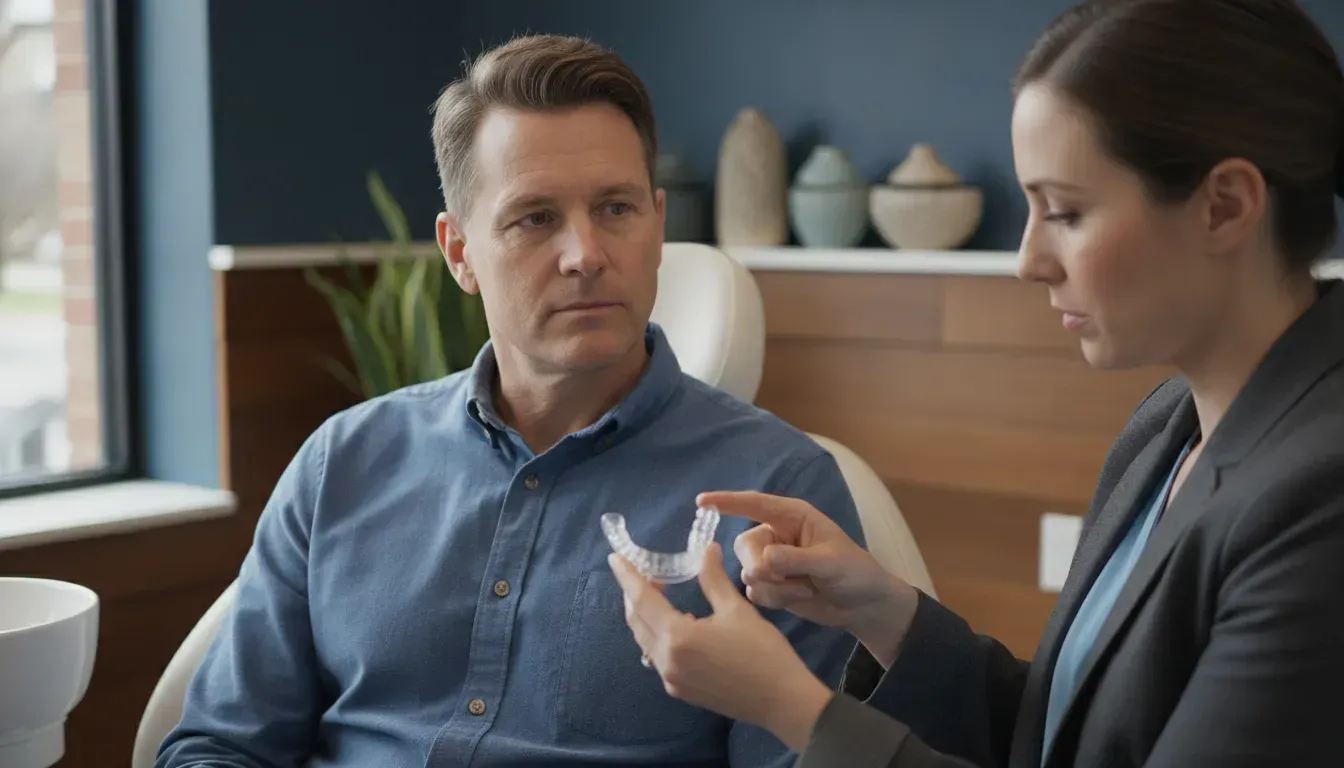
The NHLBI describes two common oral devices. Mandibular repositioning mouthpieces hold the lower jaw forward. Tongue-retaining devices hold the tongue forward. A dentist or orthodontist custom-fits the device and teaches you how to use it. That public description is not a menu of what this practice stocks, and it is not a claim that one device fits everyone. The practice's own oral appliance page explains how its clinicians choose a device for the person, including people who clench, grind, or have jaw discomfort.
Questions about diagnosis before you book
Start with the medical record, not the appliance. A second dental opinion is wasted if the diagnosis is missing or belongs to a different problem. Obstructive sleep apnea and central sleep apnea are not the same condition, and a dental appliance is discussed for obstructive disease after a physician has already made that call.
Ask these questions before you request the visit:
- Who diagnosed the obstructive sleep apnea, and do I have that note?
- Do I have a sleep-study summary I can share, or can the physician send it?
- Is my main problem CPAP tolerance, an existing appliance, or snoring after apnea was ruled out?
- Has my physician said an oral-appliance evaluation is reasonable, or am I asking the dentist to decide the medical plan?
- If I am a veteran, has my VA primary-care or sleep physician started a Community Care referral?
Formal referrals to this practice are accepted for patients a qualified physician has already diagnosed with OSA. That includes referrals that start with a dentist. If a dentist sent you without that diagnosis, the second-opinion visit cannot fill the gap. Ask the referring office to confirm the physician diagnosis first. Referring clinicians can use the practice's referral page for the letter, sample prescription, and brochure request. A brochure order is not a patient referral.
Veterans need an extra step. The practice says it participates in VA Community Care and points diagnosed, CPAP-intolerant veterans to their VA primary-care or sleep physician. Veteran status, or booking a visit yourself, does not create covered care. Eligibility, the referral, and an authorization letter still apply. Bring whatever letter you already have, and say if you do not have one yet.
CPAP tolerance and appliance candidacy
Many people ask for a second opinion because CPAP is hard to live with. Travel, mask leaks, and nights the machine stays in the closet are fair things to describe. They are not, by themselves, proof that an appliance is the right next step. The NHLBI calls positive airway pressure the most common treatment and says a provider may prescribe an oral device if you do not want CPAP or cannot tolerate it. Your physician is the person who weighs that choice. Do not stop or change prescribed therapy on your own while you seek another dental view.
When you call, describe the trouble in plain facts. Say how many nights you use CPAP, what fails, and whether you have already told the physician. A dental review can then look at whether a custom appliance is reasonable to consider. It cannot promise you will tolerate an appliance, and it cannot say CPAP is wrong for everyone.
If you already have an appliance from another office, bring it. A second look can ask whether the device matches your teeth and jaw, whether it was chosen with clenching or grinding in mind, and whether anyone planned a follow-up. The practice describes custom appliances, not a store-bought mouthguard. ProSomnus is one manufacturer whose devices may come up when the specific appliance is the point of the review. Naming a manufacturer is not a promise that one brand is stocked, covered, or right for you.
Candidacy questions worth writing down:
- What in my diagnosis and dental exam would support or argue against an appliance?
- How do clenching, grinding, or jaw discomfort change the choice?
- What would need to go back to my physician before anyone changes the plan?
- What follow-up would the dental office and the physician each own?
If jaw pain or headaches are your only concern, say that clearly. Those symptoms can matter when an appliance is selected for diagnosed OSA. They are not a reason to treat the jaw as if the visit were a TMJ clinic. The practice focus is oral appliances for sleep apnea, with snoring care only after apnea is ruled out.
Follow-up, records, and who stays involved
A second opinion often starts because follow-up never happened. Delivery of an appliance is not the end of care. Ask what check-ins were planned, what was adjusted, and what was sent back to the physician. If you cannot get those notes, write the dates you remember and bring the device.
Sleep Apnea Dental Center sees patients at three offices, and clinical days are not the same at each one. Moon Township (200 Commerce Dr., Suite 203) has clinical hours Wednesday and Thursday. Cranberry Township (20280 Route 19, Unit 6, 3rd floor) has clinical hours Monday, Tuesday, and Friday. Monroeville (118 Fox Plan Rd) has clinical hours Wednesday through Friday. Clinical hours are 8:30 a.m. to 3:30 p.m. Phones are answered weekdays from 8:30 a.m. to 4 p.m. Confirm which office can see you before you plan the day. Office hours on the locations page are not the same thing as a clinical day.
Nicole Chenet, DDS, D-ABDSM, is owner and CEO and a Diplomate of the American Board of Dental Sleep Medicine. Paige K. Murrer, DMD, and Kimberly Klein, DDS, are also ABDSM Diplomates. Haley Brose, DMD, is an AADSM Qualified Dentist pursuing Diplomate status. Not every doctor at the practice holds Diplomate status. Ask who will see you, and do not assume every clinician has the same credential. You can read the distinctions on the our doctors page.
Keep the physician in the follow-up plan. Ask who receives updates, what the physician still needs to decide, and which questions belong to the dental office. A request form is not a booked visit. Staff contact people within one to two business days to set an appointment. That window is not a treatment wait and not a fabrication timeline.
How insurance review fits a second opinion
Money questions belong in the same call as the clinical ones. The practice does not publish a fee schedule, so this guide will not quote a price. The insurance page says oral appliances fall under medical coverage when sleep apnea is diagnosed, including mild, moderate, and severe. The office checks approval before the visit so you know expected out-of-pocket cost. Approval is not a guarantee of payment. Plan terms, the device, and whether the case is snoring only can all change the result.
Bring these papers if you have them:
- The plan name and whether a prior office already requested approval.
- Any approval, denial, or "pending" letter.
- The diagnosis note, since the medical-coverage statement is tied to diagnosed sleep apnea.
- For veterans, the VA authorization letter if one exists.
A second office can review what was submitted. It cannot promise a better payment outcome, and it should not describe a free consultation. The practice does not typically offer free consults. The homepage names CareCredit as a payment option. That mention is not a set of terms, a rate, or a promise that every patient qualifies.
Ask what has been checked, what is still unknown, and what you would owe if the plan pays less than expected. Get that explanation for your own plan before you proceed. A general sentence about medical coverage is not a promise that every visit or every appliance is paid.
How to ask without starting over
You do not need to discard the first opinion to ask for another. You need a clear question and the records that let someone answer it. Call (412) 367-0367 and say you want a second opinion. Have the physician's name, the diagnosis, and whether you are asking about CPAP, an existing appliance, or snoring after a study.
Use this order so the visit stays useful:
- Confirm a physician has diagnosed obstructive sleep apnea, or say that a study ruled apnea out and you are asking about snoring.
- Gather the sleep-study summary, current therapy notes, and the appliance if you have one.
- Write three questions: candidacy, follow-up, and what insurance has approved.
- Ask which office and which clinical day can see you.
- Ask what must go back to your physician before any plan changes.
Referring offices can fax records to (412) 367-0366. If you are comparing two dental offices, ask each one the same three questions and write the answers down. Look for a direct answer about records, fit, and follow-up. Be wary of any promise that an appliance cures apnea or that every plan pays.
People come from around the Pittsburgh area, including toward Erie, Johnstown, Altoona, Weirton, and Washington County. Distance does not change the medical step. You still need the diagnosis in hand, and you still need a clinical day at Moon Township, Cranberry Township, or Monroeville that matches the schedule above.
Frequently asked questions
Can a second opinion diagnose my sleep apnea?
No. Sleep Apnea Dental Center does not diagnose obstructive sleep apnea and does not run sleep studies. A qualified physician has to make that diagnosis before a formal oral-appliance referral.
Should I stop CPAP while I wait for another dental visit?
No. Tell your physician what is hard about CPAP, and do not stop or change prescribed therapy on your own. A dental second opinion reviews the appliance question. It does not replace the medical plan.
What if I already have an oral appliance?
Bring it. A second look can review fit, jaw comfort, and whether follow-up happened. It cannot promise a different device will work better, and it is not a product catalog.
Will insurance pay for a second opinion?
Coverage depends on the plan. The office checks medical-insurance approval before the visit when sleep apnea is diagnosed. That check is not a guarantee of payment, and snoring-only care is a different question.
How fast will someone call me back?
Staff contact people who request an appointment within one to two business days. That is a response window, not a booked time and not a treatment timeline. Call (412) 367-0367 if you would rather speak with the office directly.
Request a second-opinion conversation
If you already have a physician's diagnosis and you want another dental review of CPAP trouble, appliance fit, follow-up, or insurance paperwork, call the office or send a request. Say it is a second opinion, name your physician, and list the records you can share. Staff will follow up to set an appointment. They will not diagnose apnea on that call.